

Do you remember the last time you were carded at a bar or restaurant? It was probably such a quick and normal experience, that you barely remember it. But have you ever been carded to use the internet? Being required to present your ID to access content online is becoming a growing reality for many. We're explaining the dangers of age […]

Phishing and data breaches are a constant on the internet. The single best defense against both is to use a password manager to generate and automatically fill a unique password for every site. While 1Password has recently raised their prices, and researchers have recently published potential flaws in some implementations, using a password manager […]

The Secretary of Defense has given an ultimatum to the artificial intelligence company Anthropic in an attempt to bully them into making their technology available to the U.S. military without any restrictions for their use. Anthropic should stick by their principles and refuse to allow their technology to be used in the two ways they have […]

We recently introduced a policy governing large language model (LLM) assisted contributions to EFF's open-source projects. At EFF, we strive to produce high quality software tools, rather than simply generating more lines of code in less time. We now explicitly require that contributors understand the code they submit to us and that comments and […]


Update, February 25, 2026: In response to widespread pushback, Wisconsin lawmakers have removed the provision banning VPN services from S.B. 130 / A.B. 105. The bill now awaits Governor Tony Evers’ signature. While the removal of the VPN provision is a positive step, EFF continues to oppose the bill. Advocates and residents across Wisconsin are […]

(This appeared as an op-ed published February 12, 2026 in the San Jose Spotlight, written by Huy Tran (SIREN), Jeffrey Wang (CAIR-SFBA), and Jennifer Pinsof.) As ICE and other federal agencies continue their assault on civil liberties, local leaders are stepping up to protect their communities. This includes pushing back against automated license […]

Report from EFF, Center for Just Journalism, and IPVM Helps Cut Through Sales HypeSAN FRANCISCO — A new report released today offers journalists tips on cutting through the sales hype about police surveillance technology and report accurately on costs, benefits, privacy, and accountability as these invasive and often ineffective tools come to […]

The New York Times reported that Meta is considering adding face recognition technology to its smart glasses. According to an internal Meta document, the company may launch the product “during a dynamic political environment where many civil society groups that we would expect to attack us would have their resources focused on other […]
Update February 25, 2026: Discord announced yesterday that it will delay the global rollout of its age verification system to the "second half of 2026", instead of March. The company also said it has announced stricter requirements for partners offering facial age estimation, including that the process must be entirely on-device— Discord said […]
Criticize the government online? The Department of Homeland Security (DHS) might ask Google to cough up your name. By abusing an investigative tool called "administrative subpoenas," DHS has been demanding that tech companies hand over users' names, locations, and more. We're explaining how companies can stand up for users—and covering the […]

Surveillance technology vendors, federal agencies, and wealthy private donors have long helped provide local law enforcement “free” access to surveillance equipment that bypasses local oversight. The result is predictable: serious accountability gaps and data pipelines to other entities, including Immigration and Customs Enforcement (ICE), […]

We are calling on technology companies like Meta and Google to stand up for their users by resisting the Department of Homeland Security's (DHS) lawless administrative subpoenas for user data. In the past year, DHS has consistently targeted people engaged in First Amendment activity. Among other things, the agency has issued subpoenas to […]

Amazon Ring’s Super Bowl ad offered a vision of our streets that should leave every person unsettled about the company’s goals for disintegrating our privacy in public. In the ad, disguised as a heartfelt effort to reunite the lost dogs of the country with their innocent owners, the company previewed future surveillance of our streets: a […]

Group led by EFF and Imperial Valley Equity & Justice Asks Gov. Newsom and Caltrans Director to Act Immediately SAN FRANCISCO – California must revoke permits allowing federal agencies such as Customs and Border Patrol (CBP) and the Drug Enforcement Administration (DEA) to put automated license plate readers along border highways, a […]

Interviewer: Jillian York Yazan Badran is an assistant professor in international media and communication studies at the Vrije Universiteit Brussel, and a researcher at the Echo research group. His research focuses on the intersection between media, journalism and politics particularly in the MENA region and within its exilic and diasporic […]
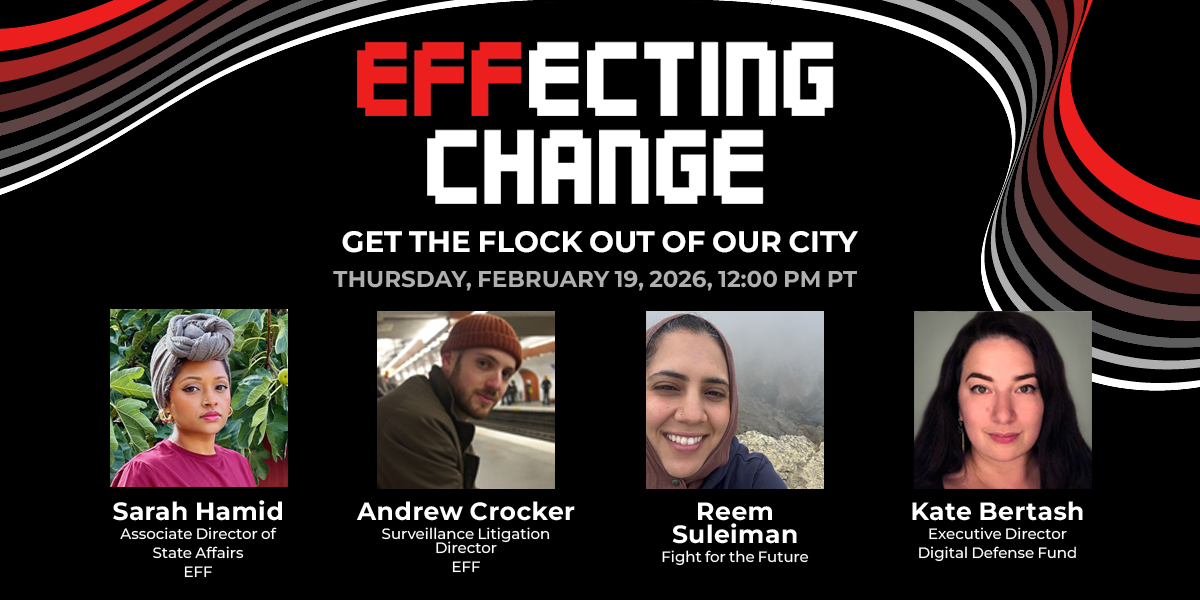
Flock contracts have quietly spread to cities across the country. But Flock ALPR (Automated License Plate Readers) erode civil liberties from the moment they're installed. While officials claim these cameras keep neighborhoods safe, the evidence tells a different story. The data reveals how Flock has enabled surveillance of people seeking […]

Section 230 helps make it possible for online communities to host user speech: from restaurant reviews, to fan fiction, to collaborative encyclopedias. But recent debates about the law often overlook how it works in practice. To mark its 30th anniversary, EFF is interviewing leaders of online platforms about how they handle complaints, moderate […]

Section 230 helps make it possible for online communities to host user speech: from restaurant reviews, to fan fiction, to collaborative encyclopedias. But recent debates about the law often overlook how it works in practice. To mark its 30th anniversary, EFF is interviewing leaders of online platforms about how they handle complaints, moderate […]

For thirty years, internet users have benefited from a key federal law that allows everyone to express themselves, find community, organize politically, and participate in society. Section 230, which protects internet users’ speech by protecting the online intermediaries we rely on, is the legal support that sustains the internet as we know it. […]

We are sad to report the passing of longtime EFF Board member, Dave Farber. Dave was 91 and lived in Tokyo from age 83, where he was the Distinguished Professor at Keio University and Co-Director of the Keio Cyber Civilization Research Center (CCRC). Known as the Grandfather of the Internet, Dave made countless contributions to the internet, […]

(This appeared as an op-ed published Friday, Feb. 6 in the Daily Journal, a California legal newspaper.) Section 230, “the 26 words that created the internet,” was enacted 30 years ago this week. It was no rush-job—rather, it was the result of wise legislative deliberation and foresight, and it remains the best bulwark to protect free […]

Immigration and Customs Enforcement (ICE) and Customs and Border Protection (CBP) have descended into utter lawlessness, most recently in Minnesota. The violence is shocking. So are the intrusions on digital rights and civil liberties. For example, immigration agents are routinely scanning faces of people they suspect of unlawful presence in the […]